
Loading bag contents...

Crimson Gilt Textile Installation by Vincent Ruijters
A thousand knitted strips in gold and crimson.
Crimson Gilt Textile Installation by Vincent Ruijters
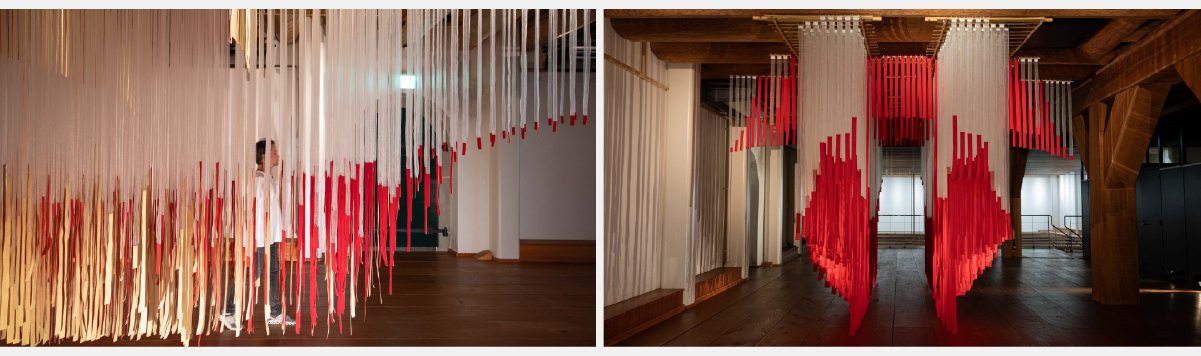
Crimson Gilt (2025) is a large-scale contemporary textile installation by Vincent Ruijters. The work reflects on the intertwined histories of Japan, Indonesia, and the Netherlands through the legacy of the Dutch East India Company (VOC). Reimagined as a suspended ship, the installation draws its form from the 1748 VOC vessel Amsterdam, translated into textile at architectural scale.
A Knitted Reflection on VOC History
The installation is constructed from more than a thousand knitted strips in gold and crimson. These colours form the conceptual core of the work. Gold represents prosperity, trade, and cultural exchange, particularly in relation to the VOC’s presence in Japan. Crimson reveals the exploitation, colonialism, and slavery that sustained trade routes across Indonesia and beyond. Together, they exist in tension, revealing the complexity of shared yet unequal histories.
Experiencing the Installation
Suspended in space, the knitted vessel invites visitors to walk through its interior. Light and colour shift as the viewer moves through the structure, creating an immersive journey through layered histories. The softness of textile contrasts with the weight of the narratives embedded within the form, allowing material, space, and movement to work together as tools of reflection.
An Installation That Travels
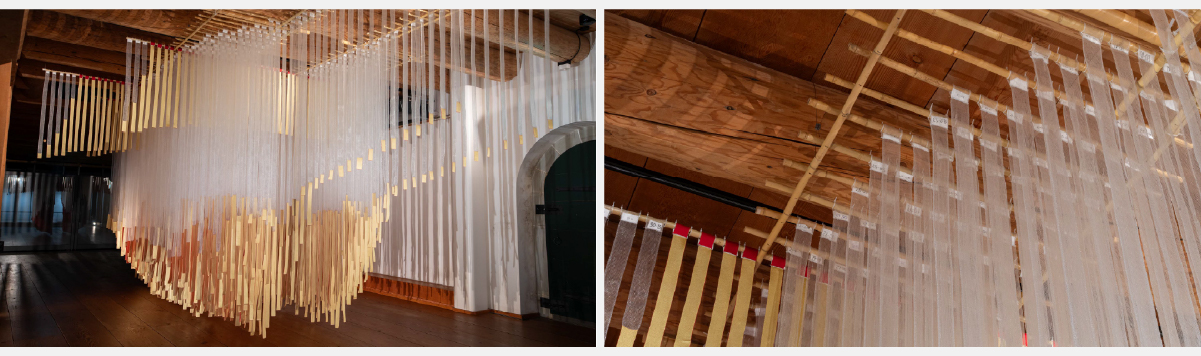
After its presentation in Hirado, Japan, Crimson Gilt travelled to the Maritime Museum of Indonesia (Museum Bahari) in Jakarta and will continue to the National Maritime Museum of the Netherlands (Scheepvaartmuseum) in Amsterdam. At each location, the installation is reoriented and reshaped, responding to the historical context and perspective of each port. The work evolves as it moves, mirroring the shifting narratives of global trade and memory.

Materials and Craft
The installation is made using knitted cotton and polyester combined with bamboo, reaching a total size of 780 × 484 × 308 cm. The textile elements were developed and produced by Knitwear Lab, bringing knitted craftsmanship into a sculptural and architectural context. The use of knitting allows repetition, rhythm, and softness to coexist with monumentality.
Sound and Spatial Atmosphere
Sound design by Yoichi Kamimura adds an atmospheric layer to the installation, enhancing the sensory experience of moving through the vessel. Sound and textile together deepen the emotional and spatial impact of the work, encouraging visitors to engage slowly and attentively.
Credits and Collaborations
Artist | Vincent Ruijters
@vincent.ruijters
Textile | KNITWEAR LAB by Guðjón Andri Þorvarðarson
Sound | Yoichi Kamimura
Planning and Coordination
Cave Ayumi Gallery
Funding
Hirado City
Embassy of the Netherlands in Japan
Mondriaanfonds
Creative Industry Fund NL
Collaborating Institutions
Hirado Dutch Trading Post Museum, Japan
Maritime Museum of Indonesia, Museum Bahari
National Maritime Museum of the Netherlands, Scheepvaartmuseum
Sponsored by
Agency for Cultural Affairs, Japan
Ministry of Health, Labour and Welfare
Nagasaki Prefecture
Executive Committee for the 40th National Cultural Festival and 25th National Arts and Culture Festival for People with Disabilities, Nagasaki
Hirado City
